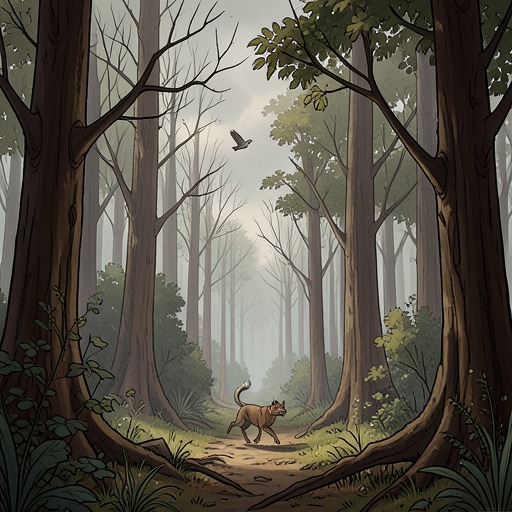
Wolves
The Dog StarsWolves are among the animals moving back toward the plains after the collapse, a return that brings new pressure into the territory around Hig and his companions. They are not simply a sign of ecological recovery: their tracks put Jasper on alert, while Bangley treats them as targets. Their presence belongs to a landscape in which some animals are reappearing even as drought and warming continue to erase others.
Return from the Mountains
Hig describes mountain Wolves drifting down over the preceding two years in ragged packs. Their growing presence is part of a wider repopulation: animals that had once been abundant are again moving into the surrounding country. The return is gradual rather than triumphant, registered as an increasing pressure on the survivors’ settled perimeter.
That movement unfolds against unstable ecological conditions. By mid-April, warmer air and altered seasons have made the old seasonal benchmarks unreliable; some recent winters left the peaks nearly bare. Hig fears this change more than attacks or disease. Wolves’ return therefore cannot stand for a general restoration: it coincides with a climate in which familiar waterways and species remain under threat.
Tracks Along the Creek
On a walk with Jasper, Hig finds two sets of wolf tracks entering and leaving the fine mud at the water’s edge, their passage marked by movement in both directions. Jasper notices them briefly. His hackles rise, but he soon turns his attention back to keeping up on the long walk, apparently tired and stiff from the season’s first extended outing.
The tracks make the Wolves’ presence immediate without bringing them into view. Hig knows they could be anywhere in the area, even though the pair are still some distance below the tracks. The encounter is brief, but it changes the creek walk from ordinary travel into an exercise in watching for what might be nearby.
Bangley’s Response
Bangley has also encountered Wolves from a distance. From the second floor of his house, he sometimes sets up at an open, sandbagged window and shoots at animals across the landscape. He kills two gray Wolves at long range; afterward, the remaining Wolves steer clear. He sews fur from one of the animals onto the hood of his winter fatigue coat and wears it as a trophy.
The episode shows how the returning animals enter the survivors’ defensive order. Bangley’s response is a show of reach and control, while Hig’s account of tracks emphasizes uncertainty and proximity. The Wolves’ movement affects human behavior even when they are not seen: their presence can prompt vigilance, and the shooting alters where they are willing to go.
Ecological Meaning
Later, Hig places Wolves among the animals moving down toward their old range, alongside bison and bighorn sheep. The same reflection names losses that have not been reversed: trout and elk are gone. There are also osprey and bald eagles, abundant mice, hawks, and crows, while spruce, fir, and aspen are coming back across miles of dead forest.
This uneven return gives the Wolves’ recovery its significance. Their reappearance is one strand in a changing ecosystem, not proof that the former world has returned. The novel presents animal life as having its own movements and fortunes, even as those changes are observed through the survivors’ practical concerns: territory, danger, and the signs of what remains.